2019년 4월 5일 금요일

‘Hot and Warm Gookbab Menu ~’ Warming You under Cold Winter in Seoul – Best Five Restaurant


Your body is always eager to ask that you need warm and hot Gookbab whenever it is entering into clod wind season in winter. As you are dumping white rice into warm and hot beef broth and take it with red hot pepper laddish Kimchi and blowing “Hu and Hu” on spoonful rice soup, you soon forget cold outside and naturally feel relax. Wwe believe there is no other menu comparing to this Gookbab Soup in winter which we could take as a convenient and easy meal or Haejanggook- good soup for the day after soup, sooth hangover after over or heavy drink.
Banryeongsan Restaurant – Hamheung Galbigook (Galigookbab)

1. Gangnam Ddaro Gookbab – Kongnamul  (Bean Sprout) Haejanggook (The Day After Soup)
This restaurant has been very well-known or popular to heavy drinker at Gangnam District in Seoul which you could enjoy either for one meal or Haejanggook. This restaurant was founded in 1980th which is older than 30 years which is serving only one single menu Kongnamul Haejanggook, soup with Kongnamul and cow blood. When they serve Haejanggook, they will always provide side dish together with Chinese cabbage Kimchi and laddish Kimchi. This Haejanggook soup is made and prepared with well enriched beef and born soup, cow front leg and brisket and add Kongnamul, laddish and big green onion. When they service the Haejanggook, they will put topping the boiled cow blood along with seasonings which will upgrade Kongnamul Gookbab. If anybody does not want cow blood, they could remove the cow blood in case you comment on order or if you want some more cow blood, they will add some more as per your request without no extra charge. They are located near to Gate No. 3 at Shinsa Station in Seoul Metro Line Number 3, tel 02-543-2527.


2. Yeongdong Seolrongtang – Beef Soup
Seolrongtang are many style depend on area by area in Korea. This restaurant is Seoul style Seolrongtang As a primary process, they broth with beef born and continuously broth with born broth after removing born. When they serve, they will add rice and seasonings so that you could feel plain and clean, no fat feel. They will serve warm rice in separate. You could now ready for enjoying Seolrongtang. Please dump the rice into Seolrongtang soup and add one or two spoonful sliced green onion which is normally on your table and help yourself along with Chinese Cabbage Kimchi and laddish Kimchi. It is normal style you pour laddish Kimchi liquid into Seolrongtang soup which will give you some sour and hot taste. They are serving laddish Kimchi liquid at pitcher in separate in order to meet this special taste or hobby. Customers are coming to this restaurant for the day after soup early in the morning. While most office salarymen are coming for lunch meal, they used to bear in mind waiting for que in order, 10 ~ 20 minutes. There is no off day all the year around.
They are located near to Gate No. 3 at Shinsa Station in Seoul Metro Line Number 3, tel 02-543-4716.  


3. Daesungjib Restaurant– Doganitang (Cow Knee Born Soup)
Doganitang is a broth soup cooking with cow knee born and tendon at ankle which is consisting with sticky liquid and less fat and containing high quality protein and minerals like calcium, prosperous, Sulphur and etc. Therefore old people used to take this Doganitang as an energy boosting menu or recovery of weak health. They were founded at middle of in 1950th as a Daeseongok Saloon. It is a brief recipe to broth cow knee born for sufficient times and add laddish, garlic, green onion to the broth after removing knee born and broth again. Please remove fat as soon as completed these broth process. It is a particular and unique taste of these broth you could feel pure and clean and pain. They are located near to Dongnipmun Station in Seoul Metro Line Number 3, tel 02-735-4259.


4. Banryeongsan Restaurant – Hamheung Galbigook (Galigookbab)

This is an old traditional food restaurant founded and running by one of Banryeongsan village lady in North Korea escaping the North Korea at Korean War and settling in South Korea and opened her restaurant under her hometown name as Banryeongsan. She presently transferred this restaurant to her son. Food style at the restaurant is Hamkyeongdo Province style in North Korea like Hamheung Naengmyeon (cold noodle), ripened flatfish, Galigookbab, Hwangtaejim, Dongtae Sundae and etc. Galigookbab is a typical menu at the restaurant boiling sufficiently  with cow rib and brisket and separately boiling cow blood, laddish, green oinion. As they serve, they will put toping with sliced briskets, cow blood piece, boiled laddish piece, green onion piece and bean curd piece. It is milder or softer or cleaner than Seoul Seolrongtang soup. They are located near to Posco Building at Samsung Station in Seoul Metro Line Number 2, tel 02-3446-8966.


5. Parkchansook Sundae Restaurant – Sundaegook (Blood Sausage Soup)

This restaurant is typical homemade style Sundaegook running more than 50 years and transferring to next generation. They are two times daily making and preparing Sundae (Blood Sausage) by their hand so as to serve the freshest Sundae taste to customers and keep it under ambient or to preserving jar. When they receive customer order, they will cut and slice the Sundae and serve together with Sundaegook. There are three typical menu like Yeongyang Sundae (Nutrition Enriched Blood Sausage), Tojong Sundae (Traditional Blood Sausage) and Kimchi Sundae (Kimchi and Blood Sausage). Yeongyang Sundae is additionally adding blood piece, potato noodle, and sticky rice as a Sundae core which give you soft and clean taste in mouth when you chew and/or sometime after swallowing. There is no particular pig flavor or smell because they treated special ingredient or process. When they serve, they will add pig head meat and organs with Sundaegook. They are located near to Hongdae Station in Seoul Metro Line Number 2, tel 02-336-9909.


Banryeongsan Restaurant – Hamheung Galbigook (Galigookbab)
Daesungjib Restaurant– Doganitang (Cow Knee Born Soup)
Gangnam Ddaro Gookbab – Kongnamul  (Bean Sprout) Haejanggook (The Day After Soup)
Parkchansook Sundae Restaurant – Sundaegook (Blood Sausage Soup) 

Yeongdong Seolrongtang – Beef Soup

2019년 3월 29일 금요일

Forget Seoul Best Naengmyeon (Cold Noodle). This is a Real Naengmyeon.


It is getting to start crowded at most famous and well-known Naengmyeon (cold noodle) restaurant in summer which you should bear in your mind waiting for sometimes on long queue before you move, despite you go there early at 11:30, about half an hour earlier than opening time at noon. Myeonplainer (nickname as Noodle Explainer) usually said “If you take cold Naengmyeon in winter sitting at warm floor heating room under clod outside, you could take an opportunity to appreciate real Naengmyeon’s mental and physical taste as well as going well with particular mood or atmosphere, taking cold noodle under cold weather. While if you take Naengmyeon at hot summer, you could not appreciate such a real unique Naengmyeon taste and atmosphere and only enjoy physical taste, making mouth and tongue happy, I could say these people are foolish and spend money for nothing”. But it is realistic situation that owner of Naengmyeon restaurant have been unusually making money in summer rather than cold winter since most people naturally feel thirsty for clod foods, Naengmyeon whenever they are tired of hot weather in summer.
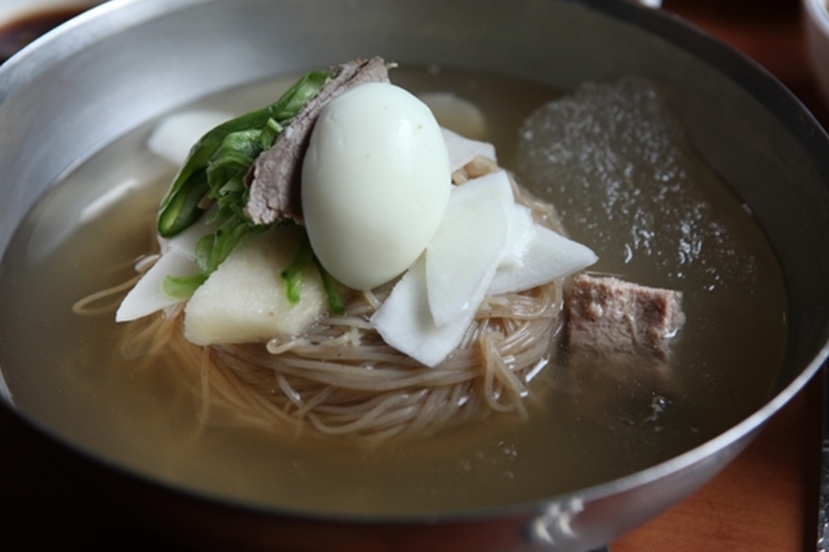
Gyeonggi Yangju Pyeongyang Myeonok Naegmyeon

There are two type of Naengmyeon, the one Pyeongyang Naengmyeon the other Hamheung Naengmyeon which is widely and generally known to many people. Pyeongyang Naengmyeon is made with well reached beef flavor broth, almost iced and topping with almost plain laddish Kimchi or cucumber Kimchi and half piece of boiled egg and one of two piece of sliced boiled beef. While Hamheung Naengmyeon is Bibim Naengmyeon mixing with boiled and cooled Naengmyeon noodles with seasoned hot spicy ingredients without broth and topping with the same as Naengmyeon as above. They will separately serving warm or cold broth depend on individual hobby. Meanwhile when they prepare Naengmyeon both, they would normally good quality of beef. But they could use other meat like pheasant or chicken or pork depending on local conditions. We are introducing best four Naengmyeon Restaurant in Korea which are more than 30 years old and still running by old seniors. Its price per bowl is less than KRW 10,000- which we could say reasonable price.

1.    Seoul Buwon Myeonok Restaurant– Boiled and Sliced Pork with Unique SeasonThere is old Naengmyeon Restaurant running more than 60 years at middle of Namdaemun Market where you could readily see many cloth shops around. They are selling Naengmyeon KRW 7.5000 per bowl which looks comparably lower at well-known Naengmyeon social restaurant than other specialized Naengmyeon Restaurant. It is the most important points that owner of Buwon Myeonok Restaurant is not only extending to next generation but also regular customers also extending to their next generation. There are some misunderstanding rumor Buwon Myeonok is making broth with pork. It is not correct. They prepare broth with high quality beep and leg born and topping with boiled and sliced pork when they are serving. They add some park when they boil which would give particular mixed broth taste. They will use this pork for topping with seasons. They are selling other particular side menu as Bindaedoek (mung bean pan cake) which cooked with pork fat and will give you mung bean flavor rich. Price is KRW 3,000 per piece. There is special menu, calling as special Naengmyeon adding some more seasoned sliced pork piece against paying extra KRW 1,500.

2. Gyeonggi Yangju Pyeongyang Myeonok : Richness of Pheasant Broth

 There is Pyeongyang Myeonok at Songchu Valley where meets with Gongneungcheon Stream at North West of Bukhansan Mountain. There are other Pyeongyang Myeonok in Seoul Jangchung Dong and Uijeongbu City. They used to call Songchu Pyeongyang Myeonok different from others. If we talk about transportation to this restaurant, they are located at suburb which is somewhat inconvenience. But there is an enough reason why people like to come to visit this restaurant since they this restaurant is using unique pheasant broth. It is quite seldom we could find Naengmyeon Restaurant using pheasant. Therefore many missing hometown people escaping from North Korea and settling at South Korea are visiting this restaurant for taking care of homesick with North Korean style Naengmyeon with pheasant.

This restaurant has been founded by North Korean, Mr. Kim in 1980 and presently running by their son. They are also making hard effort to prepare excellent broth firstly boiling with cow front leg and brisket and later adding pheasant born and meat and secondly boiling again. They sometimes serve with mixed broth with Kimchi liquid in summer in order to upgrade the broth taste. They also very carefully take care of Naengmyeon noodle which makes with buckwheat just one day before serving in order to maximize buckwheat flavor at the noodle, less flavor losing according to times. When you drink one full mouth of the broth, you could readily feel deeper broth taste than ordinary broth at other Naengmyeon Restaurants, especially particular and enriched a bit sour pheasant taste. Other menus are available like North Korean Style Chicken Soup KRW 28,000, Nokdujigim (mung bean pancake) KRW 8,000 and handmade dumpling KRW 8,000.

3.  Gunsan Pbopai Naengmyeon : secrete dark black Color Broth
There are some well-known restaurants in Gunsan City to Seoul like Chinese Restaurants, bread shop and old story telling Naengmyeon restaurants. This Naengmyeon Restaurant is    the Pbopai Naengmyeon Restaurant many running more than 63 years which was founded in 1954 at Gunsan Bus Terminal as “Wonjo Pyeongyang Naengmyeon Restaurant” and was changed its name as Pbopai Naengmyeon Restaurant in referent to very widely known Pbopai at TV cartoon program in 1960th . There is unique and particular of Naengmyeon broth at this restaurant as dark black color which is making soya source, mineral enriched natural salt and other secrete ingredients. When they serve, they will topping with boiled few chicken breast and 2 or 3 pieces of sliced pork which they used for making special and unique broth. It is key point how to make their broth; first sufficiently boiled cow leg born, secondly boiling with chicken breast for about 3 hours, lastly boiling with pork. They said each home is making Naengmyeon broth with each style in North Korea. But the founder was stick to this style and confidentially transferring this method to next generation. These are menu as Naengmyeon KRW 7,000 and Wongmandu (Big Dumpling) KRW 4,000.

4.  Jinju Iehyenodong Hayeonok Naengmyeon : Unique Add Seafood Looks likes Memil Soba (Japanese Cold Noodle)
There is no Naengmyeon Restaurant competing with unique and special broth at this Jinju Hayeonok Restaurant since they use not only cow front leg but also many kinds of seafood for making unique broth. There are several other Naengmyeon Restaurants in Jinju City But this Jinju Iehyenodong Naengmyeon Restaurant is an original and best Naengmyeon Restaurant in Jinju which was founded in 1945 as “Pusan Sikyook Sikdang”. This restaurant has been nowadays running by the Founder’s last son in law. Typical menu is Mulnaengmyeon (Pyeongyang Style) KRW 8,000and Yookjeon (beef pancake) KRW 19,500 and Bibim Naengmyeon (Hamheung Style) KRW 9,000. Please note they use the same topping between Pyeongyang Naengmyeon and Hamheung Naengmyeon. 

Jeonbuk Gunsan Pbopai Naengmyeon

Gyeonggi Yangju Pyeongyang Myeonok Naegmyeon


Gyeongnam Jinju Iehyeondong Naengmyeon

Seoul Buwonmyeonok Naengmyeon

2019년 3월 1일 금요일

Incheon Gangwha Manisan Mountain Hike – Hamheo Dongcheon Course


1.   Date and Time : Feb 26, 2019 10:00 ~12:00 (4 hours including one hour break).

2.   Location : Hwado-eup, Ganghwa-District, Incheon Metropolitan City in Korea

3. Distance and Course : About 11.15km. Course is to start at Hamheo Dongcheon Parking Lot => Hamheojeong => Jungsusa Temple Junction => 114 Stairs => Seven Angel Stairs => Jungsubi-Major Repair Monument => 472.1m Altitude Manisan Summit => Chamseongdan-Memorial Service to Dangun, Korea National Founder => back to the Parking Lot through the same ascending course. Please see “Incheon Gangwha Manisan Hike- Hamheo Dongcheon Course Map” and https://www.youtube.com/watch?v=9u1OmGb-0B8&t=264s

4.   Overall Mountain Explanation.

In the Hamheodongcheon flows water upon the 100-meter-high rock bed where the letter Hamheodongcheon carved by Hamheodaesa himself. Hamheo Dongcheon means Area where you could see crystal blue sky without any cloud. Whether or not because Goryeo was invaded too often and tried to defend the country with the aid of Buddha through Buddhist rituals and services, there are numerous venerable temples in Ganghwado.

There are Jeondeungsa (Temple), Jeongsusa (Temple), Jeokseoksa (Temple), Baengnyeonsa (Temple), Cheongnyeonsa (Temple), and many more temples such as Bomunsa (Temple) in Seongmodo (Island), where Nahancheonjinseoksang (stone statue), discovered by a fisherman from the sea, is enshrined. Hwagaesa (Temple) of Yi Saek, Mogeun, and Seonwonsa (Temple) sites also still remain without damage. You can observe various treasures while visiting the mountain.
Hamheo Dongcheon Stream

5.   Detailed Hike Course Explanation.

      I have been several times hiking Gangwha Manisan Mountain through Gangwha National Tour Center which is located at North Manisan and never tried to take other course, Hamheo Dongcheon Course locating at South East Manisan. I decided to take this course and arrived at the Hamheo Dongcheon Parking Lot some minute before 10 o’clock in the morning and prepared to start the hike. As I walked for a while, I passed ticket booth paying entrance fee and kept walking some more and reached the Junction which was the way going to the same Manisan Summit through valley at left or ridge at right. I chose left road and kept walking easy concrete paved road for about 20 minutes from the parking lot and reached the junction between Manisan Summit at straight and 70m to Hamheojeong at right. I turned right at the junction and walked up the hill for about 5 minutes and found Hamheo Dongcheon Pavilion which was used for break or observation at old days. I went up the Hamheojeong and over looked West Sea which looks sound and beautiful scenery. I moved back to hike course and continued to walk the concrete paved road and saw nice scenery of white clouds running over Manisan Ridge and recorded it to the camera. As I walked this road for about 10 minutes more, I reached real hike starting area changing the concrete paved road to ordinary soil hike road and found great water stream completely frozen at left and shot the good scenery at good angle. I started to move on the real hike road and realized I had to walk steeper uphill. When I walked this road for about 10 minutes more, I reached Jungsusa Temple Junction; 1.6km to the Manisan Summit at right and Jungsusa Temple at left. I took a right direction at the junction and kept moving up through steeper rocky uphill for about half an hour and reached114 Stair Way connecting to the Jungsu Ridge which was built on very highly sloped uphill and hardly walking through the stairs. I reached the Jungsu Ridge Junction after one more half an hour walking on the stairs and looked down West Coast and small islands at the sea and could see lose bigger rocky road on the ridge leading to the Summit. I hardly walked this rocky and slippery road for about 20 minutes and found Jungsubi-Major Repair Monument of Chamseongdan and tried to read and understood its explanation. As I continued to walk this rocky ridge raid for 10 minutes, I finally touched down 472.1m Altitude Manisan Monument and looked around the Summit and saw Chamseongdan just at next close peak and moved there less than 10 minutes walking and learned or confirmed Chamseongdan is area for memorial service to Dangun, Korea National Founder as well as taking fire with convex lens on the Porch to National Sport Festival. There was a fantastic event dancing around the firing spot area with impressive dressing like at the photo. I fully looked around the Chamseongdan and Summit and descended through the same way as I ascended this morning and pleasantly enjoyed packed lunch box at good and proper area, sunny and no windy.  
Hamheo Dongcheon Parking Lot

Facility Map Around the Parking Lot

Junction; Valley Course at Left and Ridge Course at Right

Easy Walking Concerte Paved Road 

Junction; 70m to Hamheojeong at Right and Summit at Straight


Hamheojeong Pavilion; Break and Observation

looking Down to West Sea


Hamheo Dongcheon Stream

Walking Along with Hamheo Dongcheon Stream

Jungsusa Temple Junction; 1.6km to Manisan Summit at Right


Highly Sloped Uphill Rocky Road

114 Stairs Connecting to Jungsu Ridge

Steeper and Harder Uphill

Junction at Middle of Stairs; Jungsusa Temple at Left

Looking Down to Around Peaks

Last Pitch to Jungsu Ridge on Top of Stairs

Small Vilage at Foot of the Manisan Mountain. 

Rocky and Slipery and Lose Rocky Road at Ridge


Close View of the Summit and Chamseongdan  


Jungsubi-Monument of Major Repair Works at Chamseongdan

472.1m Altitude Manisan Mountain Summit Monument 

Relevant Photo of Chamseondan Cremony 

Chamseongdan-Memorial Ceremony to Dangun, Korea National Founder

View of Jungsu Ridge from the Chamseongdan

Small Village and Small Islands at the West Sea  

Seven Angel Stairs

114 Stairs at Jungsu Ridge Junction

Very Harsh and Steeped Ridge Walking 

Mysterious Rocks at the Ridge

Deck Road Connecting to the Down Hill

Deeply Sloped Downhill Road


2019년 2월 24일 일요일

Gyeongbuk Bongwha Cheongnyangsan Janginbong Mountain Hike – Ha Cheongnyang Course


1.
1.   Date and Time : Feb 18, 2019 10:00 ~14:00 (4 hours including one hour break).
2.   Location : Bukgok-ri, Myeongho-myeon, Bonghwa-District, Gyeongsangbuk Province in Korea
3. Distance and Course : About 6.67km. Course is to start at Ha Cheongnyang Parking Lot => Dudeul Village Junction => Gorge Junction => Cheongnyangsan Janginbong Summit (870m Altitude) => Gorge Junction => Sky Suspension Bridge => Gorge Junction and back to the Parking Lot through the same ascending course. Please see “Gyeongbuk Bongwha Cheongnyangsan Hike Map” and https://www.youtube.com/watch?v=R3mKXmPw3EM&t=19s  
4.   Overall Mountain Explanation.
      It is located 29km away to the southeast from Bonghwa-eup and 24km away to the northeast from Andong-si (city). It is a representative attraction of Bonghwa-gun visited by over 20,000 tourists per year. It is a noted mountain which is called little Geumgangsan (Mt.) since time immemorial because of its graceful natural views. Cliffs with fantastic rocks are made up of 6 peaks and Nakdonggang (River) is flowing along the mountain from Taebaeksan (Mt.)
There are 27 sites of temples and monk's cells in the mountain and also a lot of historic relics; Yuribojeon (Tablet) established by Great Buddhist Priest Uisang, Cheongnyangjeongsa (Temple) where Yi Hwang, Toegyeo made a synthesis of philosophy while he was cultivating his minds, Goundae and Dokseodang (library), relics of Choe Chiwon, Gimsaenggul (Cave) where Gim Saeng studied, Goingminwangdang (Shrine) which King Goingmin hid in, and a fortress etc. In addition, Sinseondae where Taoist hermits played Paduk and Seonnyeobong (Peak) where fairies enjoyed singing and dancing. With all of them, this mountain was known as a mystic and beautiful place throughout the four seasons.
Beautiful Jasobong Peak on the Way Dwon to Gorge Junction

5.   Detailed Hike Course Explanation.
      It was my plan taking back to Seoul today after short hike to Cheongnyangsan less than 5 hours and trying to hurry up coming to Ha Cheongnyang at 9 o’clock. But I could not make it because transportation in Bongwha was not so easy driving road, narrow and sharp curvatures. I cane there just before 10 o’clock and rushed to start hike at Ha Cheongnyang as preplanned. I came to Cheongnyangsan Hike Course Map at the Cheongnyang Waterfall area and found landmark at starting area stating as 1.9km to Janginbong Summit and 2 km to Sky Suspension Bridge which means I could make it possible to hike to Janginbong less than 4 hours for round trip and started to move on somewhat inclined concrete paved road. As I walked this road for about half an hour, I reached Dudeul Village Junction stating as 1.5km to the Summit and 1.6km to Sky Suspension Bridge at Right and 50m to Dudeul Village at Left. I turned right at the Junction and heard so sweet and tender music somewhere at the Junction and also so lovely natural bird sing at bushes on the valley which became as a fantastic music together. I was really immersed to this unusual nature situation. If someone asked me as “Are you Happy?”. I was definitely Yes, Yes, Yes. As I started to move up the dried stream path, I found stony and rocky road on very sharply inclined uphill . But I was not so hard and difficult because of such so beautiful nature bird sing and tender lovely soft and attractive music. I walked on this road for about 10 minutes and found stair way arranging on closer to vertical uphill. I was no more hear so attractive music and bird sing and kept walking on this stair way and severely sloped bush road on uphill for about 20 minutes and reached Gorge Junction between Janginbong Summit at left and Seonhakbong Peak at right. There was junction at the junction stating as 300m to the Summit at left and 500m to the Sky Suspension Bridge. I took a short break at the junction and moved on left direction heading to the Summit and soon found one more sharply inclined steel stair way going to the Summit. I was slowly step by step and passing the Stairs and met continuously steep uphill and finally arrived at the top of 870m altitude Cheongnyangsan Summit after 2 hour and 30 minutes struggling hike. I was looking around the Summit for a while but was not able to see around due to taller woods fencing around. I so started to walk down through ascending road and found so beautiful Jasobong Peak in front on the way down and took a nice view on the camera. When I walked up to Seonhakbong Peak via Gorge Junction, I found landmark on the uphill stating as 400m to the Sky Suspension Bridge. But the road to the Bridge was also deeply inclined uphill and hard to move fast. I was therefore slowly step by step and moving forward for about 10 minutes. There was a cute small suspension bridge appearing in front which was connecting between Seonhakbong Peak and Jasobong Peak as see at the photo and Video. I was enjoyed nature beauty around the Bridge and started to descend the Cheongnyangsan Mountain via Gorge Junction, Dudeul Village Junction and Cheongnyang Waterfall. When I was almost walking down to Ha Cheongnyang Village, I saw frozen waterfall on the valley and immediately interpreted this waterfall should be a Cheongnyang Waterfall. I closer to the Ha Cheongnyang Village and moved to the Cheongnyang Waterfall and found suitable size waterfall for easily look at one shot, no need look moving eye here and there. Anyhow I took a photo and video properly and attached for your appreciation herein. I was eventually backing to the parking lot after 4 hours hike, up and down.
Parking Lot at Ha Cheongnyang Village


Landmark at Ha Cheongnyang Village; 1.9km to Janginbong Summit and 2 km to Sky Suspension Bridge

Typical Concrete Paved Steep Uphill Road to Dudeul Village


Dudel Junction; 1.5km to the Summit and 2 km to Sky Suspension Bridge

Walking Rocky and Stony Dried Stream Road on Highly Slped Uphill 

Very Sharply Inclined Stair Way on Uphill

Deeply Slped Bush uphill Road 

Closer to Gorge Junction


Gorge Junction; 300m to Janginbong Summit at Left and 500m to Sky Suspension Bridge

One More Heavily Inclined Steel Stair Way

Reaching to 870m Altitude Cheongnyangsan Summt

Beautiful Jasobong Peak on the Way Dwon to Gorge Junction

Landmark after Gorge Junction; 400m to the Sky Suspension Bridge

Small but Cute Sky Suspension Bridge. Jasobong Peak is Behind

Around View at the Bridge

One More Around View at the Bridge

Sky Suspension Bridge at different Angle

Closer View of Jasobong Peak at the Bridge


Completly Frozen Cheongnyang Waterfall